Using AI to reward safe driving.
It’s Friday. We’re mere hours away from the last long weekend of the summer. We’ve got a jam-packed edition to help fill the hours between morning coffee and downing tools.
In today’s edition:
- How this fleet safety company is using AI to reward good driving behavior
- More than a third of businesses are tapping AI to fight fraud
- Demand for AI chips remains strong amid bubble anxiety
—Jordyn Grzelewski, Patrick Kulp, Annie Saunders
AI
Safety first
Jon Tetzlaff/Getty Images
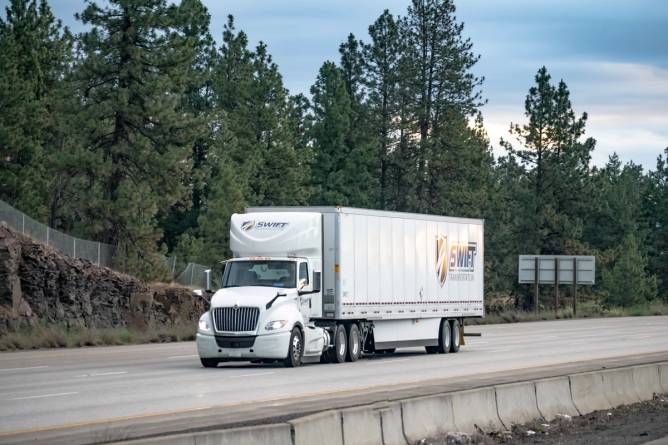
Fleet safety company Netradyne’s solutions are backed by AI—as well as by a decidedly less technological tool: positive reinforcement.
The San Diego-based company, founded in 2015, is built on the idea that focusing on the positive over the negative—with cutting-edge tech to help—can help make roads safer.
“Why not tell someone they’re doing a good job every day?” Adam Kahn, Netradyne’s chief business development officer, told Tech Brew. “If I can, every day, put a little star next to your name and say you did a good job that day, you’re shifting the safety culture to a reward-based safety culture versus a punitive-based safety culture—and that has monumental increases across fleet results.”
On the road: Safety is a pressing issue in the trucking industry and in transportation overall, given the steep number of traffic fatalities in the US every year.
Netradyne’s solution is a safety platform equipped with “cutting-edge HD video safety and management technology powered by advanced AI,” according to the company. The platform uses vision-based object detection to analyze “every minute of drive time with up to 99% accuracy.” The company has analyzed more than 20 billion driving miles.
AI
Fraud fighters

Alexsecret/Getty Images
Digital fraud is on the rise, in part because of generative AI fakery. Can AI also guard against these threats?
That’s what businesses seem to be betting on, according to a new report from Experian. It found that 37% of more than 200 companies surveyed are using generative AI to detect and protect against fraud. Meanwhile, nearly three-quarters (72%) of them expect that deepfakes and other AI-generated scams will be among their top challenges by next year.
“AI has emerged as both a savior and a saboteur in the fraud ecosystem,” the authors wrote.
Through GenAI-powered capabilities like deepfakes and voice cloning, the technology has supercharged certain types of impersonation scams. But AI can also help businesses better flag anomalies and suspicious behavior to get ahead of potential threats, the report said. Major credit card companies, for instance, have been using various forms of machine learning and AI to combat fraud activity for years—since the 1990s, in Visa’s case.
And yet fraud remains an increasingly costly problem, according to the report.
AI
What bubble?

Justin Sullivan/Getty Images
With fears swirling about an AI bubble, many were watching Nvidia’s rundown of its quarterly performance with bated breath—even more so than usual.
Sales of the company’s chips not only serve as a temperature check on AI fever but also a read on the market’s health as a whole, given that AI spending now accounts for a growing chunk of the country’s economic growth.
All the heightened stakes didn’t yield anything too dramatic, though: In a somewhat familiar arc, the world’s most valuable company narrowly beat most analyst consensus estimates for its Q2 performance, while its stock dipped slightly, partly due to just how inflated expectations already were.
Nvidia said it made $46.7 billion in the quarter that ended in late July, up 6% from Q1 and 56% YoY. An LSEG analyst poll had expected around $46 billion, according to CNBC. The company predicted that it’ll pull in $54 billion during the current quarter, above the $53.1 billion analyst estimate.
But there were also some weaker spots in the report.
COOL CONSUMER TECH
Usually, we write about the business of tech. Here, we highlight the *tech of tech.*
Cha cha slide into my DMs
Anna Kim
Spotify is debuting an in-app messaging feature in an effort to encourage users to remain in the app, Morning Brew’s Dave Lozo wrote this week. “The new feature, which Spotify says users want, may make paying a higher monthly fee seem worth it,” Lozo wrote, noting that it’s possible for users to opt out of the feature or block others. (We do apologize for the preceding bold text that instantly transported you to the portion of a wedding reception when certain guests have had one too many and collectively decide that line dancing is a good idea.)
Math it out
As of Sept. 30, the $7,500 federal tax credit for buying an EV will be no more. Still thinking about going electric? The New York Times created a calculator to give drivers a sense of how they can get the most bang for their buck when factoring in gas (or electricity) and maintenance.
JOBS
More focus, less fluff. CollabWORK filters out the noise and delivers jobs that actually match what Tech Brew readers are looking for. Click here to see the full board of curated roles.
- Systems Engineer II at Raytheon (in person)
- Manager, Product Management at Mastercard (in person)
- Manufacturing Operations Manager at Consolidated Precision Products (in person)
- Principal Systems Engineer, Missile Systems Radar Signal Processing at Raytheon (in person)
- Sr. Staff Software Development Engineer at Maxar Technologies (in person)
Written by Jordyn Grzelewski, Patrick Kulp, and Annie Saunders